

Autumn Term Reception Maths Resources – Early Years Maths Foundations Scheme

Here you will find everything you need to teach our story-led maths scheme in the Autumn term, created to support White Rose Maths and the Early Years Foundations Stage Framework.

Week 1 and Week 2 - Getting to Know Me
Spend the first 2 weeks in the autumn term getting to know your children and carrying out maths baseline assessments, using 4 familiar rhymes.
These two weeks of teaching are completely optional, offering rhyming stories, tuff trays, activities, small world packs, baseline assessment documents and more to kickstart your autumn term maths teaching and prepare the children for block 1.
Block 1 - Match, Sort and Compare

Week 3
Our Week 3 content for book 1 Match, Sort and Compare is FREE to view/download.
Sniffles the hedgehog loves autumn and has found the perfect way to celebrate the season.
Our original story Sniffles and the Autumn Crown was written to support children as they learn to match objects and pictures as well as identify a set.
Match Objects
Match pictures and objects
Identify a set

527
FREE - Sniffles' Leaf Match Activity
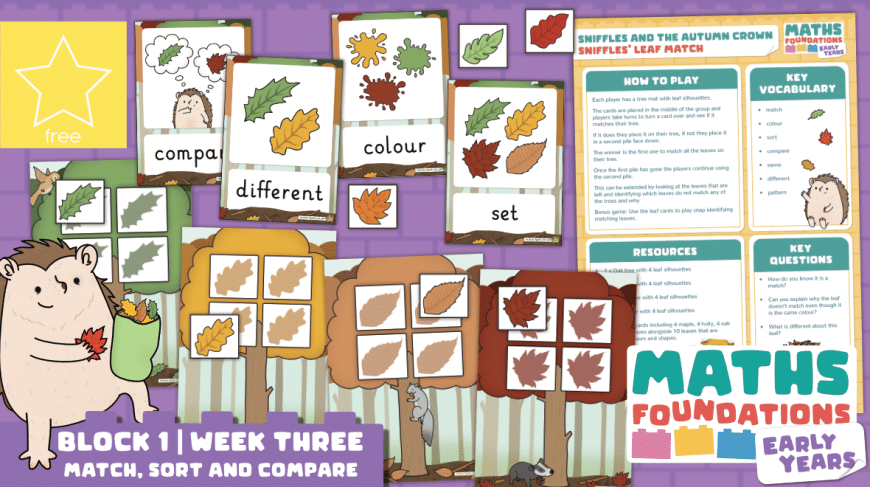
Designed to build foundational concepts like matching, sorting, and comparing, this hands-on resource encourages children to explore patterns, colours, and shapes through leaf identification.
374
FREE - Sniffles and the Autumn Crown Teaching Essentials
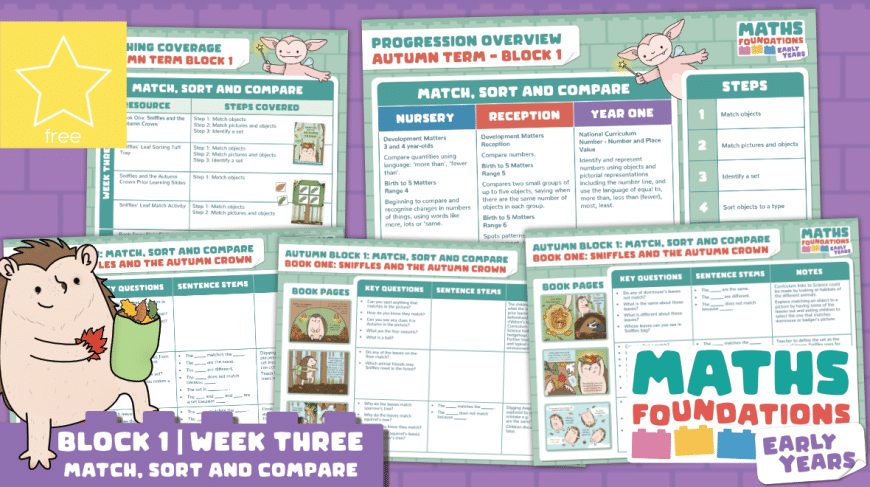
This Maths Foundations Early Years Teaching Essentials pack gives you everything you need to prepare to teach Block 1 Week 3 Match, Sort and Compare in the Autumn term of Reception.
357
FREE - Sniffles and the Autumn Crown Prior Learning Slides
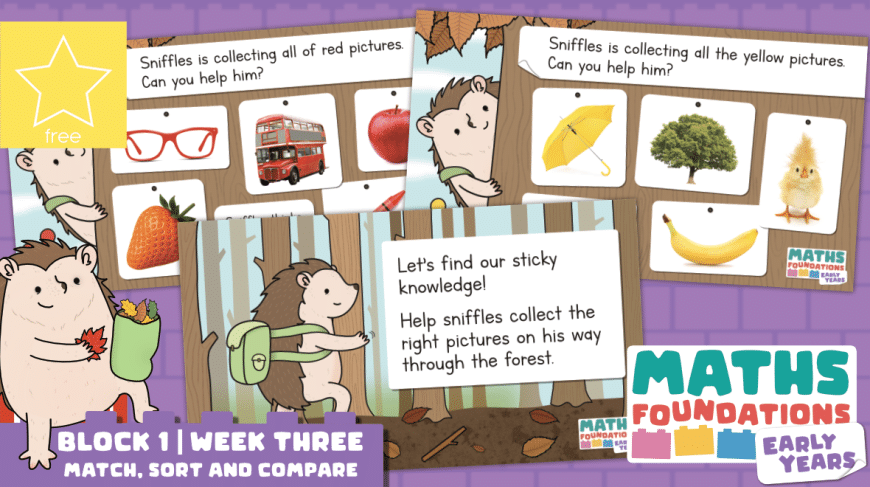
This interactive and engaging PowerPoint asks the children to help Sniffles the hedgehog and use their colour and shape matching skills to find all the correct objects.
499
FREE - Sniffles' Leaf Sorting Tuff Tray
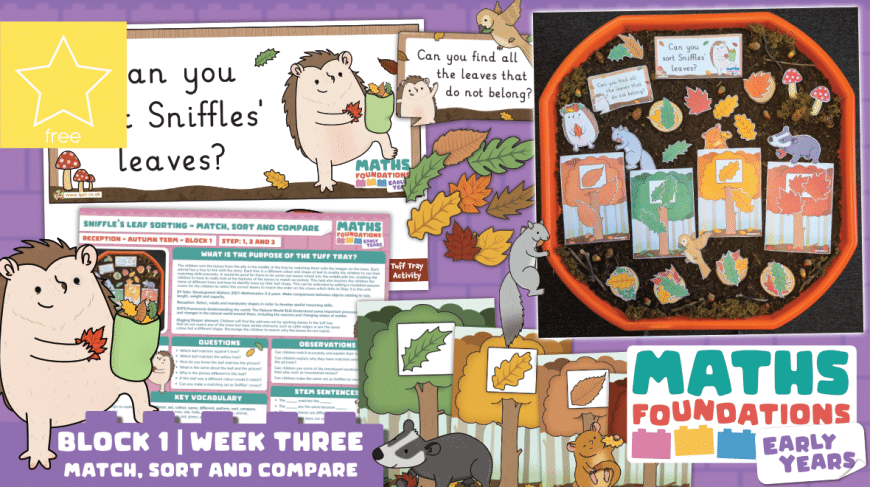
Children will explore early mathematical skills as they sort and match autumn leaves by colour, shape, and type—using both printed and real leaves.
108
FREE - Sniffles and the Autumn Crown Lesson Plans

Our daily maths lesson plans provide you with whole-class starters, teaching input, adult-led activities, key vocabulary and a full list of the resources needed for each lesson.

Week 4
In Week 4 for Match, Sort and Compare, the children will read book 2 in our original maths storybook series, Flo’s Birthday Bug Grub, designed to support children as they explore sorting techniques, sorting objects to a type and creating their own sorting rules.
Join Flo and her friends for a bugtastic birthday party, there’s lots to sort!
Sort objects to a type
Explore sorting techniques
Create sorting rules
231
Bug Grub Surprise

Children take turns creating ‘bug grub’ by secretly sorting insects by colour, size or type, while their partner guesses the sorting rule.
This engaging activity builds essential skills for matching, sorting, and comparing, while encouraging rich maths talk and collaborative play.
188
Flo's Birthday Bug Grub Teaching Essentials
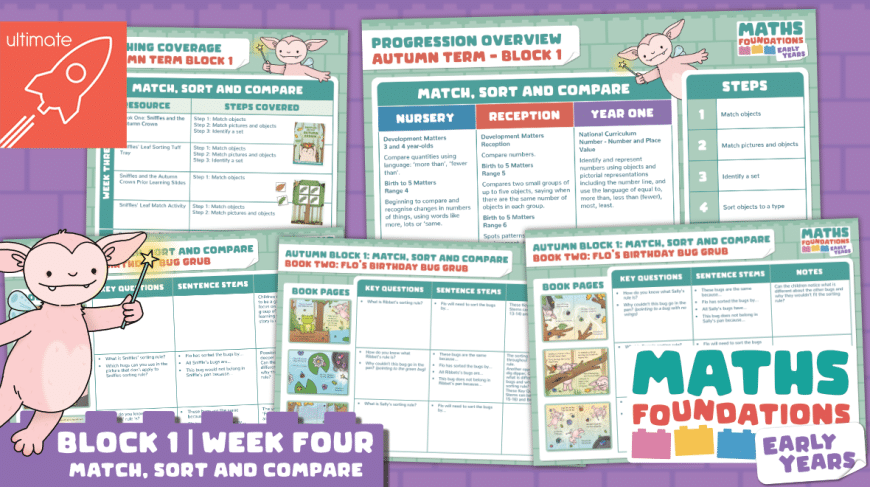
This Maths Foundations Early Years Teaching Essentials pack gives you everything you need to prepare to teach Block 1 Week 4 Match, Sort and Compare in the Autumn term of Reception.
235
Flo's Birthday Bug Grub Prior Learning Slides
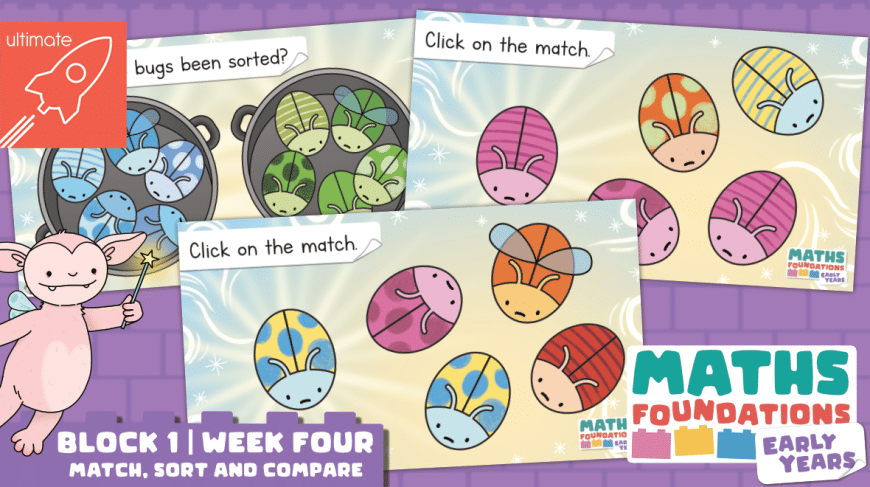
This interactive PowerPoint asks the children to help Flo the woodland fairy to find the matching bugs using their colour, pattern and shape matching skills.
274
Bug Grub Sorting Tuff Tray

This engaging setup encourages children to sort bugs by colour, shape and size, or spot the odd one out, and explore multiple sorting strategies.
214
Bug Poop Scoop Tuff Tray
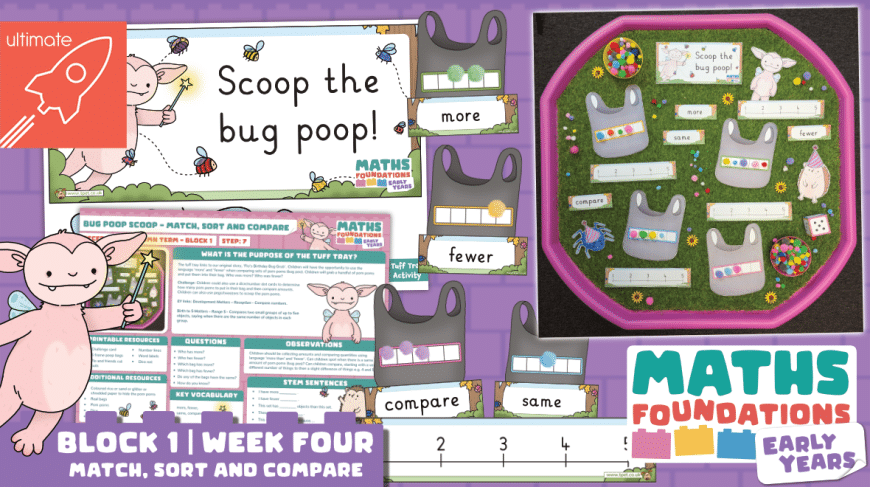
This engaging setup encourages children to scoop pom poms (bug poo) into bags, then compare using key vocabulary such as 'more', 'fewer', and 'same'.
90
Flo's Birthday Bug Grub Lesson Plans

Our daily maths lesson plans provide you with whole-class starters, teaching input, adult-led activities, key vocabulary and a full list of the resources needed for each lesson.
Block 2 - Talk About Measure and Pattern

Week 5
In Week 5 the children will begin Block 2 maths Talk about Measure and Pattern.
Our original story book 3 Dibble’s Dream Day and supporting resources, will provide children with opportunities to explore comparing size, mass and capacity as Dibble the dog wakes up and decides that today is the perfect day to do all his favourite things.
Compare Size
Compare Mass
Compare Capacity
201
We're Going on a Stick Hunt Activity

Children hunt for sticks, compare and order them from shortest to longest, and use Duplo or Lego bricks to measure their length. This hands-on task strengthens mathematical language, reasoning, and recording skills, all while connecting learning to the natural world.
178
Dibble's Dream Day Teaching Essentials

This Maths Foundations Early Years Teaching Essentials pack gives you everything you need to prepare to teach Block 2 Week 5 Talk about Measure and Pattern in the Autumn term of Reception.
169
Dibble's Dream Day Prior Learning Slides

This interactive PowerPoint asks the children to visit the park with Dibble and help him and his friends to compare different amounts.
228
Weighing Treats Tuff Tray

Children create playdough treats for Dibble, Whiskers and friends, then use balance scales and compare bears to investigate which items are heavier, lighter, or equal in weight.
212
Bath Time Measuring Tuff Tray

Children help Dibble and his dog friends choose the right bubble bath containers by comparing how much water each holds.
87
Dibble's Dream Day Lesson Plans

Our daily maths lesson plans provide you with whole-class starters, teaching input, adult-led activities, key vocabulary and a full list of the resources needed for each lesson.

Week 6
Our Week 6 content for Talk about Measure and Pattern is centred around book 4’s original maths story, Waddles’ Welly Walk. Follow Waddles the duck on a welly walk through town. What patterns will he find?
Our original story and supporting content were written to provide opportunities for children to copy, continue and create simple patterns.
Explore simple patterns
Copy and continue simple patterns
Create simple patterns
190
Pattern Puddles Activity

Children match colourful welly boot cards to complete repeating patterns on their puddle mats, then extend their learning by creating and continuing their own patterns. With bonus games for extra challenge, this resource encourages reasoning, vocabulary building, and matching skills.
144
Waddles' Welly Walk Teaching Essentials

This Maths Foundations Early Years Teaching Essentials pack gives you everything you need to prepare to teach Block 2 Week 6 Talk about Measure and Pattern in the Autumn term of Reception.
181
Waddles' Welly Walk Prior Learning Slides

This interactive PowerPoint asks the children to help Waddles’ the duck, find his matching wellington boots before he goes on his walk.
230
Welly Pattern Match Tuff Tray

Children explore repeating patterns by matching, continuing, and creating welly boot sequences using colourful puddle mats and cut-out wellies.
79
Waddles' Welly Walk Lesson Plans

Our daily maths lesson plans provide you with whole-class starters, teaching input, adult-led activities, key vocabulary and a full list of the resources needed for each lesson.
Block 3 - It's Me 1, 2, 3

Week 7
In Week 7 the children will begin Block 3 maths It’s Me 1, 2, 3.
Our original story book 5 Stitches’ Busy Harvest and supporting resources, will provide children with opportunities to explore finding, subitising and representing numbers 1, 2 and 3 as Stitches the scarecrow gets everything on the farm ready for harvest.
Find 1, 2, 3
Subitise 1, 2, 3
Represent 1, 2, 3
216
Build a Scarecrow Activity

Children pick a card showing a quantity (e.g. 2 buttons) and add the correct number of items to their own Stitches the scarecrow.
This engaging resource supports counting, subitising, numeral recognition, and one-to-one correspondence for numbers 1, 2 and 3, all within an autumn harvest theme.
164
Stitches' Busy Harvest Teaching Essentials

This Maths Foundations Early Years Teaching Essentials pack gives you everything you need to prepare to teach Block 3 Week 7 It’s Me 1, 2, 3 in the Autumn term of Reception.
172
Stitches' Busy Harvest Prior Learning Slides

This interactive PowerPoint gets children to explore the farm with Stitches the scarecrow, to see what patterns they can find.
250
Harvest Counting Tuff Tray

Children match quantities to the correct numbered tractors or baskets using subitising, numeral recognition, and one-to-one correspondence.

Week 8
Our Week 8 content for It’s Me 1, 2, 3 is centred around book 6’s original maths story, The Enormous Pumpkin Pull. Join Willow and her friends as they try to pull an enormous pumpkin out of the ground.
Our original story and supporting content were written to provide opportunities for children to explore 1 more, 1 less and the composition of numbers 1, 2 and 3.
1 More
1 Less
Composition of 1, 2, and 3
194
The Big Pumpkin Count Activity
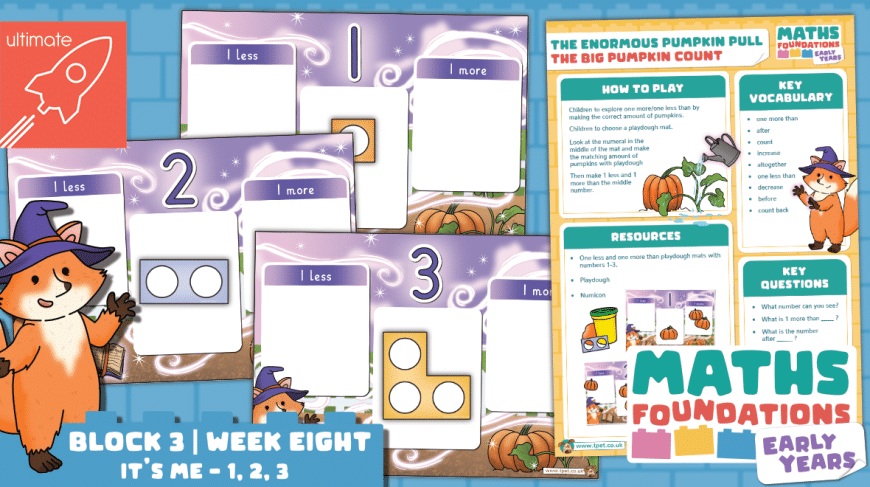
Children build the correct number of pumpkins from playdough, then create one more and one less than the number shown.
This engaging task supports counting, number recognition, and early calculation in a playful, autumnal context..
129
The Enormous Pumpkin Pull Teaching Essentials
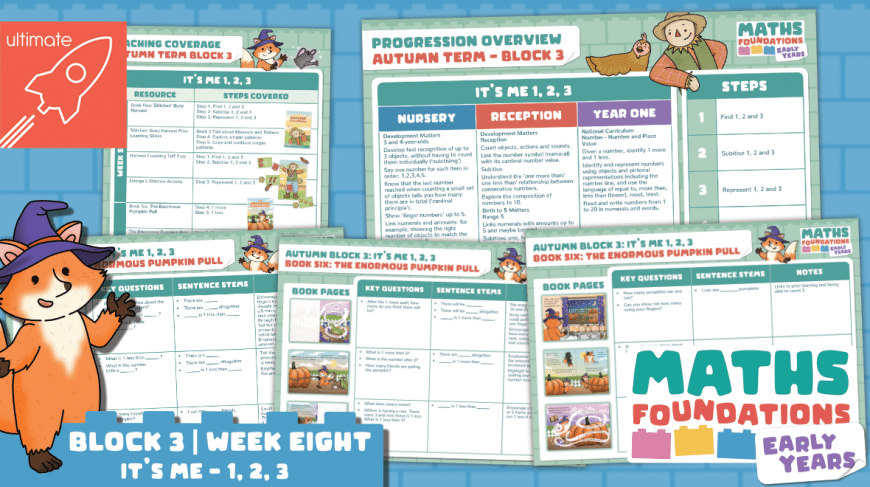
This Maths Foundations Early Years Teaching Essentials pack gives you everything you need to prepare to teach Block 3 Week 8 It’s Me 1, 2, 3 in the Autumn term of Reception.
182
The Enormous Pumpkin Pull Prior Learning Slides

This interactive PowerPoint asks children to help Willow in her pumpkin patch. The children will find, subitise and represent numbers 1, 2 and 3.
159
The Enormous Pumpkin Pull Story Retelling Tuff Tray
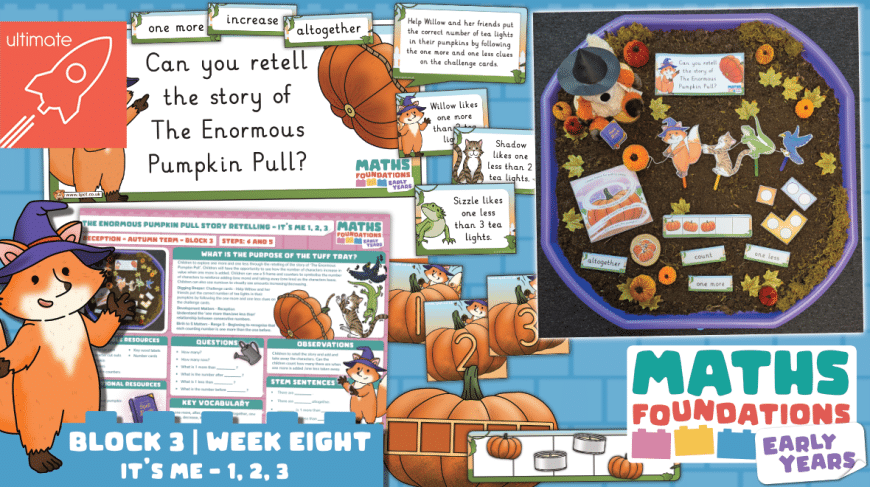
As children act out the seasonal tale using character cut-outs and props, they use 5 frames, counters, and Numicon to visually represent how numbers increase and decrease with each turn of the story.
159
Pumpkin Planting Tuff Tray

Children help Willow arrange pumpkins in fields using small-world props, learning how numbers can be made up of smaller parts. This playful approach to partitioning supports deep understanding of number structure and prepares children for addition concepts.
Block 4 - Circles and Triangles

Week 9
In Week 9 the children will cover Block 4 maths Circles and Triangles.
Our original story book 7 Hoot’s Surprise and supporting resources, will provide children with opportunities to identify and name circles and triangles as well as look at shapes in the environment and describe their position, as Hoot the owl experiences her first Bonfire Night.
Identify and name circles and triangles
Compare circles and triangles
Shapes in the environment
Describe position
199
Build Hoot the Owl Activity

children practise recognising 2D shapes, comparing size, and using key positional language such as on top, next to, under, and behind.
143
Hoot’s Surprise Teaching Essentials

This Maths Foundations Early Years Teaching Essentials pack gives you everything you need to prepare to teach Block 4 Week 9 Circles and Triangles in the Autumn term of Reception.
145
Hoot’s Surprise Prior Learning Slides

This interactive PowerPoint asks children to help Hoot the owl find all the ways that show 1, 2 or 3. This prepares the children before moving onto identifying triangles by having 3 sides in Block 4 Circles and Triangles..
221
Hoot’s Playdough Fireworks Tuff Tray

This engaging setup encourages children to practise recognising 2D shapes, comparing size, and using key positional language such as on top, next to, under, and behind.
Block 5 - 1, 2, 3, 4, 5

Week 10
In Week 10 the children will begin Block 5 maths where they focus on the numbers 1, 2, 3, 4, 5.
Our original story book 8 The Snowman Olympics and supporting resources, will provide children with opportunities to find, subitise and represent numbers 4 and 5 and explore the composition of 4 and 5 as the North and South Pole Snowmen get ready for the Snowman Olympics.
Find 4 and 5
Subitise 4 and 5
Represent 4 and 5
Composition of 4 and 5
139
Candy Cane Bowling Activity

Children roll a ball to knock down numbered “candy cane” bottles, then count how many they’ve toppled.
By identifying numerals and dot arrangements (1–5), children strengthen subitising, number recognition, and early addition skills—all while engaging in active, playful learning.
135
Carrot Toss Activity

Children develop number recognition and subitising skills as they toss hoops over numbered “carrot” bottles filled with orange water.
Children identify the numeral or dot arrangement they’ve caught—building confidence in counting, number language, and visual number patterns.
122
The Snowman Olympics Teaching Essentials

This Maths Foundations Early Years Teaching Essentials pack gives you everything you need to prepare to teach Block 5 Week 10 1, 2, 3, 4, 5 in the Autumn term of Reception.
117
The Snowman Olympics Prior Learning Slides
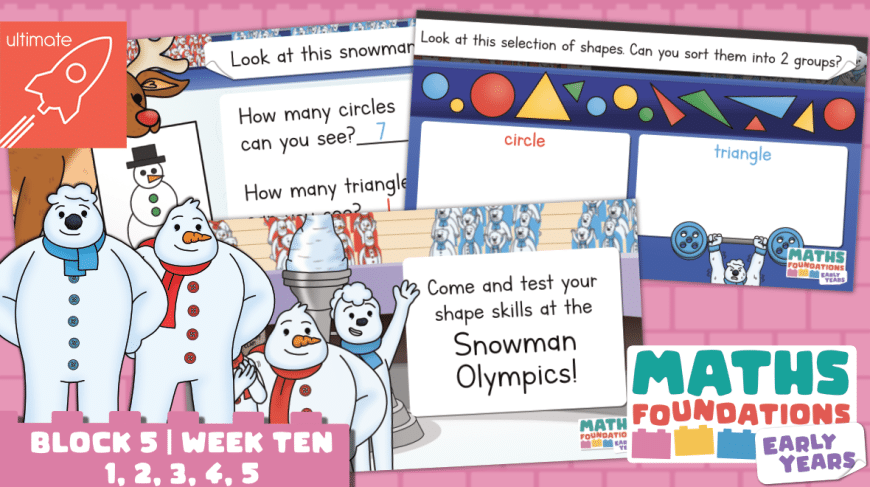
This interactive PowerPoint challenges the children test their shape skills at the Snowman Olympics by identifying shapes and their features as well as describing position.
186
Snowman Hockey Tuff Tray

Children count, subitise, and match number balls to goal representations using ping pong balls, Numicon, and buttons.
Children explore different ways to represent numbers and develop their understanding of cardinality and number composition.

Week 11
Our Week 11 content for 1, 2, 3, 4, 5 is centred around book 9’s original maths story, Five Little Penguins. Join Poppy and her penguin friends as they have a narrow escape from a hungry whale.
Our original story and supporting content were written to provide opportunities for children to explore 1 more, 1 less and the composition of numbers 1-5.
1 more
1 less
Composition of 4 and 5
Composition of 1-5
146
Playdough Penguins Count Activity

Using the rhymes from our original story, counting mats, and playdough or penguin characters, children add and remove penguins from the huddle as the story unfolds.
134
Five Little Penguins Teaching Essentials

This Maths Foundations Early Years Teaching Essentials pack gives you everything you need to prepare to teach Block 5 Week 11 1, 2, 3, 4, 5 in the Autumn term of Reception.
141
Five Little Penguins Prior Learning Slides

This interactive PowerPoint asks the children to help sort the penguin pictures by working out which picture is the odd one out, ordering the pictures and finding 4 and 5.
262
Penguin Counting Tuff Tray

Children use number penguins, mini counters, and number frames to practise counting, identifying one more and one less, and understanding number order to 5.
205
Five Little Penguins Story Retelling Tuff Tray

As children retell the story using penguin characters, icebergs, and sea scenes, they partition numbers (up to 5), practise saying stem sentences like “___ is a part of ___”, and investigate different ways to make a whole number.
Block 6 - Shapes With 4 Sides

Week 12
In Week 12 the children will cover Block 6 maths Shapes with 4 Sides.
Our original story book 10 It’s a Wrap! and supporting resources, will provide children with opportunities to identify, name and combine shapes with 4 sides as well as look at shapes in the environment and explore night and day as Tinsel the elf prepares for the busiest season of the year.
Identify and name shapes with 4 sides
Combine shapes with 4 sides
Shapes in the environment
My night and day
147
We’re Going on a Shape Hunt Activity

children explore 2D shapes, with 4 sides, in their environment.
As they search for squares and rectangles in everyday objects—like windows, doors, or presents—children learn to identify shapes, describe their properties, and sort by size.
131
Sequencing Tinsel’s Day Activity

Children sequence the events of Tinsel’s day and talk about them using time-related vocabulary such as first, then, before, and after.
111
It’s a Wrap! Teaching Essentials

This Maths Foundations Early Years Teaching Essentials pack gives you everything you need to prepare to teach Block 6 Week 12 Shapes with 4 Sides in the Autumn term of Reception.
109
It’s a Wrap! Prior Learning Slides

This interactive PowerPoint asks children to help tinsel the elf to count the presents in the workshop as he adds more and takes presents away.
185
Tinsel’s Shape Sorting Tuff Tray

Children become Tinsel’s workshop assistants, they sort square and rectangle presents into the correct sacks—exploring shape properties like sides, corners, size, and orientation.
146
Wrapping Paper Printing Tuff Tray

Children explore shape composition through hands-on printing. Children will use square and rectangle Duplo bricks to stamp wrapping paper, discovering how shapes can be combined to form new ones.
Week 1 and Week 2 - Getting to Know Me
For the first 2 weeks of reception maths teaching, we have introduced a Getting to Know Me section, supporting you to carry out maths baseline assessments, using 4 familiar rhymes.
These two weeks of teaching are optional. They offer rhyming stories, tuff trays, activities, small world packs, baseline assessment documents and more to kickstart your autumn term maths teaching and prepare the children for block 1.

In Week 1 the children will focus on the familiar rhyme Five Little Speckled Frogs. This story and its supporting resources will help you to carry out a baseline assessment for numbers to 5 recognition, counting and ordering, as you get to know the children.

In the second half of Week 1 the children will focus on the familiar rhyme Ten Fat Sausages. This story and its supporting resources will help you to carry out a baseline assessment for numbers to 10 recognition, counting and ordering, as you get to know the children.

In Week 2 the children will focus on the familiar rhyme 5 Little Men in a Flying Saucer. This story and its supporting resources will help you to carry out a baseline assessment for numbers to 5 recognition, counting, ordering, one less and how many now? As you get to know the children.

In the second half of Week 2 the children will focus on the familiar rhyme 1, 2, 3, 4, 5, Once I Caught a Fish Alive. This story and its supporting resources will help you to carry out a baseline assessment for numbers to 10 recognition, counting, matching and ordering, as you get to know the children.
Getting to Know Me
For the first 2 weeks of reception maths teaching, we have introduced a Getting to Know Me section, supporting you to carry out maths baseline assessments, using 4 familiar rhymes.
These two weeks of teaching are optional. They offer rhyming stories, tuff trays, activities, small world packs, baseline assessment documents and more to kickstart your autumn term maths teaching and prepare the children for block 1.

Week 1
In Week 1 the children will focus on the familiar rhyme Five Little Speckled Frogs. This story and its supporting resources will help you to carry out a baseline assessment for numbers to 5 recognition, counting and ordering, as you get to know the children.
214
5 Little Speckled Frogs Teaching Essentials

This Maths Foundations Early Years Teaching Essentials pack gives you everything you need to carry out a maths baseline assessment at the start of the Autumn term of Reception.
186
5 Little Speckled Frogs Small World

Perfect for maths-rich continuous provision, this activity blends rhyme, role play, and early numeracy in an inviting, open-ended setup.
161
5 Little Speckled Frogs Outdoor Activity

Children hop like frogs through numbered hoops, retrieve beanbags, and sing along to the classic rhyme—all while developing gross motor skills, communication, and early maths understanding.
336
5 Little Speckled Frogs Tuff Tray

Children use tweezers or pegs as “frog tongues” to collect pom-pom bugs and feed them to the frogs, counting as they go. With opportunities to explore the 5 counting principles and match numerals to quantities, this sensory-rich setup also supports early mathematical talk and playful pattern recognition.

Week 1
In the second half of Week 1 the children will focus on the familiar rhyme Ten Fat Sausages. This story and its supporting resources will help you to carry out a baseline assessment for numbers to 10 recognition, counting and ordering, as you get to know the children.
157
10 Fat Sausages Teaching Essentials

This Maths Foundations Early Years Teaching Essentials pack gives you everything you need to carry out a maths baseline assessment at the start of the Autumn term of Reception.
133
10 Fat Sausages Small World

Children act out the rhyme using sausage and pan props, magnetic numbers, and playdough while counting down and exploring number concepts in a hands-on way.
124
10 Fat Sausages Obstacle Course

Children carry 10 sausages (sticks) in a pan as they complete a fun obstacle course, trying not to drop any along the way. Linked to the well-loved rhyme, this activity builds number recognition, physical control, and language skills.
124
10 Fat Sausages Throwing Game

Children develop early number skills and coordination as they aim and throw sausages (beanbags) into a chalk-drawn pan. This active maths game reinforces counting, number conservation, and gross motor control in a fun and collaborative way.
211
10 Fat Sausages Tuff Tray

This tuff tray activity combines role play with early maths, giving children the chance to count, match numerals to quantities, and follow breakfast orders using sausages, bacon, and eggs. Children play café chef—preparing meals, filling orders, and exploring numbers up to 10.

Week 2
In Week 2 the children will focus on the familiar rhyme 5 Little Men in a Flying Saucer. This story and its supporting resources will help you to carry out a baseline assessment for numbers to 5 recognition, counting, ordering, one less and how many now? As you get to know the children.
112
5 Little Men in a Flying Saucer Teaching Essentials

This Maths Foundations Early Years Teaching Essentials pack gives you everything you need to carry out a maths baseline assessment at the start of the Autumn term of Reception.
115
5 Little Men in a Flying Saucer Small World

Children act out the rhyme by removing one alien at a time from the flying saucer, reinforcing the concept of subtraction and number order. With number cards, alien figures, moon rocks, and a space-themed setup, this activity encourages repeated counting, prediction, and number recognition through imaginative play.
112
5 Little Men in a Flying Saucer Outdoor Activity

Children orbit a chalk-drawn earth with hoops as flying saucers, joining and leaving the group as the verses progress. This fun, active session supports number recognition, subtraction through song, physical coordination, and group participation.
240
5 Little Men in a Flying Saucer Tuff Tray

Children practise counting, numeral recognition, and early subtraction as they place aliens into numbered flying saucers and remove one as they sing the rhyme.

Week 2
In the second half of Week 2 the children will focus on the familiar rhyme 1, 2, 3, 4, 5, Once I Caught a Fish Alive. This story and its supporting resources will help you to carry out a baseline assessment for numbers to 10 recognition, counting, matching and ordering, as you get to know the children.
126
1, 2, 3, 4, 5, Once I Caught a Fish Alive Teaching Essentials

This Maths Foundations Early Years Teaching Essentials pack gives you everything you need to carry out a maths baseline assessment at the start of the Autumn term of Reception.
113
1, 2, 3, 4, 5, Once I Caught a Fish Alive Small World

Children move toy fish along a number line as they sing, helping them connect spoken numbers to numerical order. With prompts to show numbers on fingers and identify left and right hands, this activity supports early maths skills, number sense, and rhyme recognition in a playful, tactile way.
120
1, 2, 3, 4, 5, Once I Caught a Fish Alive Outdoor Activity

Children use nets to catch numbered fish from a water tray and thread them onto a string to build a number line from 1 to 10. This playful task strengthens counting, number sequencing, and fine motor skills, while promoting communication and confidence through rhyme and role play.
211
1, 2, 3, 4, 5, Once I Caught a Fish Alive Tuff Tray

Children use fishing rods to catch numbered fish, match them to number boards, and count out mini fish counters to show each amount. They can also represent numbers on their fingers, supporting early number recognition, one-to-one correspondence, and the cardinal principle.


